.png)
3 Reasons to Align Your Curriculum Approval Process With Your Catalog Publication Cycle
Misaligned curriculum and catalog timelines cause delays, gaps, and student confusion. Here are 3 reasons alignment matters, and what's at stake.

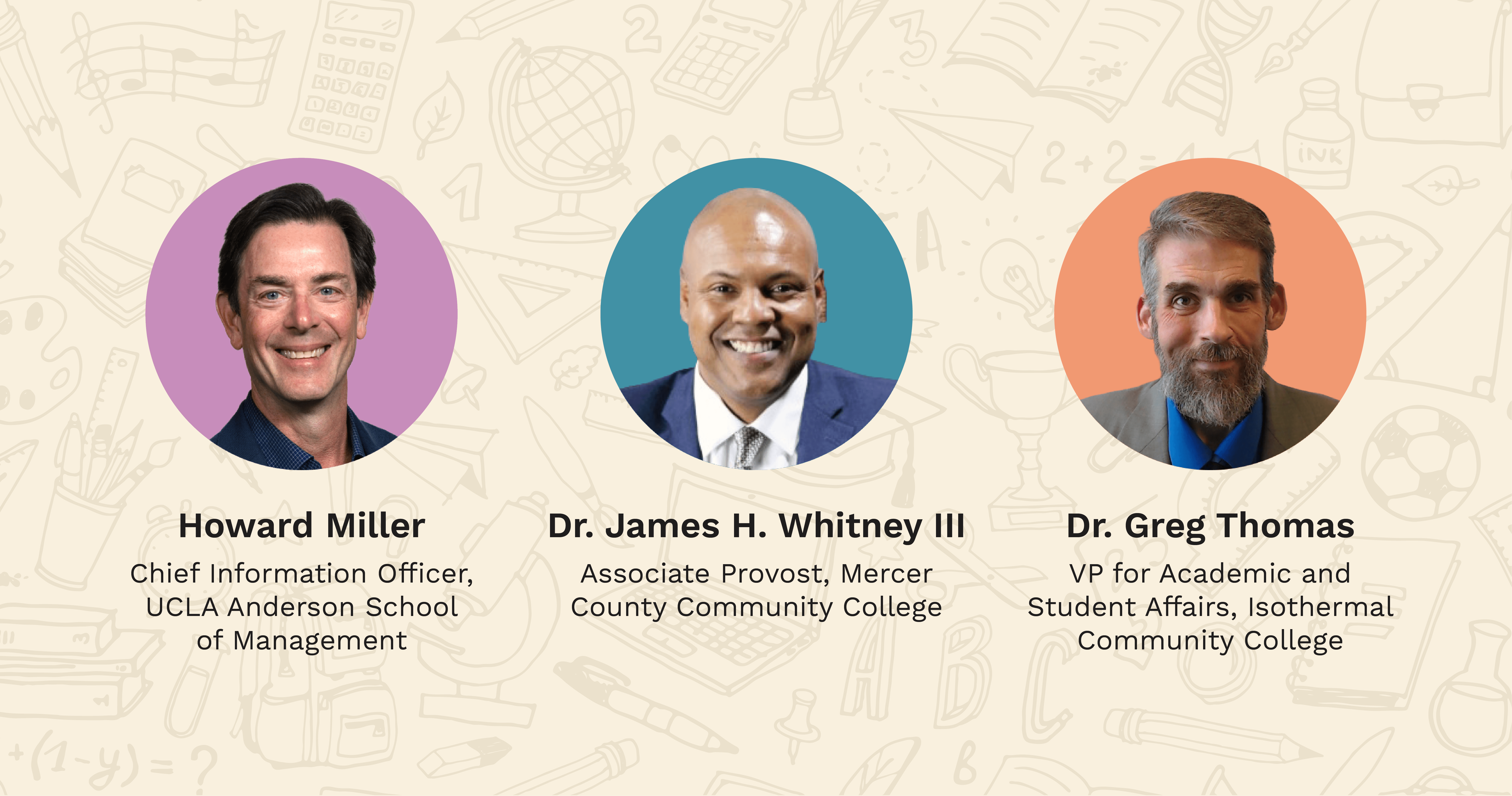

When CIO Howard Miller decided to go live with production AI agents at the UCLA Anderson School of Management over two years ago, most institutions were still debating AI policies. His reasoning was straightforward: inaction carried more risk than action. This framing is one that academic operations leaders across institution types are starting to share.
Recently, Inside Higher Ed and Coursedog brought Miller together with Dr. James Whitney III, Associate Provost at Mercer County Community College, and Dr. Greg Thomas, Vice President for Academic and Student Affairs at Isothermal Community College, for a webinar. The session, Closing the AI Gap: From Early Adopters to Smart Ops, provided insights from three higher ed leaders with extensive AI experience. They spoke about their experiences moving from curiosity to implementation, the use cases that worked, the resistance they navigated, and what they wish they'd known earlier.
In a recent AACRAO survey of academic operations professionals, 85% said they think AI can meaningfully improve efficiency on their campuses. But when asked whether their institution is actually using AI in academic operations today, only 11% said yes. That gap reflects the extensive effort of building conditions for adoption, from securing executive buy-in to establishing data governance frameworks to equipping staff with the confidence to use new tools.
However, the broader higher education picture suggests that momentum is accelerating. A recent Ellucian report found that institution-wide AI adoption rose from 49% to 66% in one year, with 88% of institutions expecting further growth. Dr. Whitney framed it simply: "AI was already here. It was just how we were going to pick it up." AI adoption looks different for every school, but the key is to start taking action.
At UCLA Anderson School of Management, Miller and his team built an AI agent trained exclusively on five years of course syllabi. Faculty, staff, and students can query it directly to understand historical meeting patterns, check attendance policies across courses, or help craft a schedule around specific constraints. Miller was deliberate about starting there. "It's a clean data set," he noted. "It's only our data. It's clean, it's robust." That compartmentalization kept the risk low and the time to value short.
At Mercer County Community College, Dr. Whitney uses AI to generate course summaries for the catalog, a use case that extends beyond internal efficiency. As Whitney put it, the tool helps faculty "say what we need to say, but say it in the language that students are going to respond to." The result is public-facing catalog copy that serves prospective students, continuing students, and the broader community without requiring extensive time to craft.
Dr.Thomas took a different approach entirely at Isothermal Community College, bringing AI directly into the classroom. A math instructor piloted a closed-circuit AI tool loaded exclusively with his own course materials, lesson plans, and recorded lectures. Students were encouraged to use it on their homework, but the tool walked them through the steps before delivering an answer. On the back end, the instructor could see exactly where students were struggling and adapt in real time. The pilot proved successful and has since expanded into English, history, and humanities courses.
Not everyone on campus will be an early enthusiast, and the panelists were candid about that reality. Thomas offered a straightforward framework for working with reluctant faculty: hear them out first. "When you have an instructor who comes to you and they're reluctant to let their students use AI, the first thing you have to do is just hear them out and acknowledge their feelings," he said. From there, leaders can help them see how AI produces better outcomes for students. "The resistance generally just goes away," he noted.
Miller took a similarly patient approach, choosing to work with willing adopters rather than mandating institution-wide adoption. The strategy has paid off in unexpected ways. A recent training session drew three times the attendance of comparable sessions in 2025, and over 60 faculty members have requested Claude licenses, many of whom had previously been disengaged. Miller pointed to Claude Code as the turning point, giving non-technical faculty the ability to build tools, automate tedious tasks, and see firsthand what AI could do for their work. "When you can show somebody how they can approach AI personally to help them do their jobs more effectively," he said, "that's when that light bulb goes on."
Thomas offered the thought-provoking analogy that people once said calculators were cheating. Now a professional engineer without one on their desk would raise eyebrows. Institutions moving forward on AI are not dismissing concerns. They are finding ways to highlight early wins and show faculty the value firsthand.
The question of what AI means for students appears in each use case the panelists described. At UCLA Anderson, the syllabus agent gives students a resource available around the clock. At Mercer, AI-generated catalog copy helps prospective students understand what a course offers before they enroll. At Isothermal, a closed-circuit classroom tool is turning homework into a guided learning experience rather than a shortcut to an answer.
The broader stakes go beyond individual tools. Miller spoke directly about what employers are signaling: they are not going to hire graduates who cannot use AI to make business decisions. Whitney sees AI as a leveling force for first-generation students who arrive with gaps that traditional institutional support has never fully addressed. Thomas pointed to students in his rural North Carolina community who are using AI to build businesses and expand their opportunities in ways that simply were not available before.
All three perspectives share a common conviction that the institutions best positioned to serve students are the ones engaging with AI now, on their own terms, rather than waiting until the technology forces their hand.
.svg)

.png)