.png)
3 Reasons to Align Your Curriculum Approval Process With Your Catalog Publication Cycle
Misaligned curriculum and catalog timelines cause delays, gaps, and student confusion. Here are 3 reasons alignment matters, and what's at stake.


Each term, registrars and academic schedulers face the same pressure: build a schedule that works for students, fits available space, respects faculty constraints, and holds up through registration. The tools institutions use to manage that process vary widely, and so do the results.
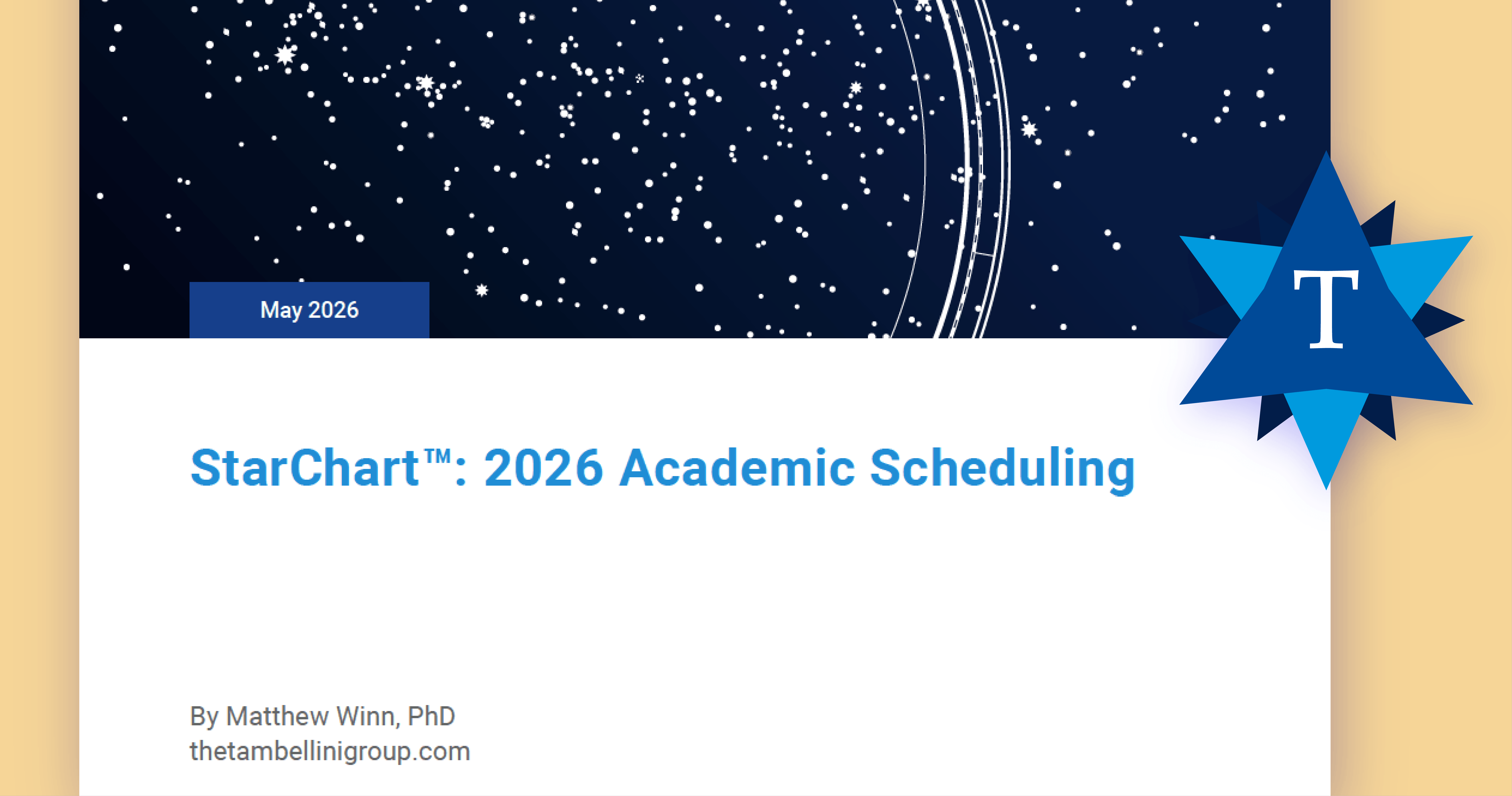
In May 2026, The Tambellini Group released their StarChart for Academic Scheduling, an independent evaluation of vendors scored across usability and innovation. Vendors are placed in one of three orbits: Commander, the highest tier reserved for market leaders in both usability and innovation; Navigator, representing platforms with strong and adaptable capabilities; and Specialist, for more narrowly focused solutions. This article breaks down who the major vendors are, what each brings to the table, and what institutions should consider when evaluating their options.
Accruent EMS has a long-standing presence in higher education, particularly among institutions focused on campus-wide space and event coordination. The platform covers room scheduling, event management, exam scheduling, and classroom assignment. It also integrates with operational systems including Outlook, digital signage, and HVAC alongside major student information systems.
The Tambellini Group placed EMS in the mid-tier Navigator orbit of the 2026 StarChart, and described it as a focused scheduling solution. Based on publicly available information, institutions looking for integrated section and room optimization, custom scheduling rules and fields, predictive course demand projections, or class relationship management built natively into their scheduling platform may want to evaluate whether EMS is the right fit for those requirements.
With nearly 30 years in the market, Ad Astra’s platform covers course, room, event, and exam scheduling in a comprehensive environment. The platform is positioned around the idea that smarter scheduling can support student completion and institutional financial health. Faculty scheduling tools sit within the same workflow, giving schedulers visibility into instructor availability, teaching history, and workload without leaving the platform.
The Tambellini Group placed Ad Astra in the Commander orbit of the 2026 StarChart, behind one other vendor, recognizing its maturity as a scheduling platform. However, institutions that want scheduling connected to broader academic operations functions like curriculum management, catalog, and faculty workload as part of a single platform may want to evaluate whether a more unified academic operations vendor better fits their needs.
CollegeNET's Series25 suite is a widely adopted scheduling platform. It is built around three core components: 25Live for event and space scheduling, Schedule25 for automated classroom assignment, and X25 for space utilization analytics and scenario modeling. In the StarChart, CollegeNET ranked last of the four vendors that the Commander orbit is comprised of.
The platform is suitable for institutions prioritizing room optimization and campus-wide event coordination at scale. Alternatively, institutions looking for department-level scheduling workflows with approval routing, instructor preference forms, or predictive course demand projections built natively into the platform should evaluate how extensively those capabilities are supported before moving forward.
Where most scheduling vendors focus on one or two domains, Coursedog is built to coordinate across all of them. The platform covers course, room, event, and exam scheduling in a single cloud-native environment, and connects those functions directly to curriculum management, catalog, faculty workload, and course demand projections. For institutions managing scheduling alongside broader academic operations processes such as faculty assignments, that means working from a shared data model rather than syncing information across multiple systems.
Natively, the platform supports department-level workflows with approval routing, instructor preference forms, predictive demand projections, enrollment heatmaps, and registration monitoring. The Tambellini Group placed Coursedog at the top of the Commander orbit of the 2026 StarChart, earning the highest marks for both usability and innovation. The report cites its capacity for sustained innovation and its integration across the broader academic operations ecosystem as differentiators.
CourseLeaf CLSS is a course scheduling and section planning platform built by Leepfrog Technologies, designed to centralize scheduling across departments, apply institutional rules, and optimize class placement. The platform includes visualization tools that give schedulers a view of how courses are distributed across meeting patterns and time blocks, with conflict detection built in.
CourseLeaf was listed as a commander on the StarChart, behind Ad Astra and Coursedog. However, according to the report CourseLeaf does not appear to maintain a detailed public-facing product roadmap, which can make it harder to evaluate where the platform is headed. Institutions prioritizing integrated section and room optimization or highly configurable scheduling fields may want to confirm how those capabilities are supported within CLSS.
Modern Campus Schedule is a focused course scheduling platform that helps institutions manage section creation, instructor assignments, room usage, and scheduling workflows from a single dashboard. Conflict detection is built into the workflow, surfacing faculty and room overlaps. The platform sits within the Modern Campus Connected Curriculum suite alongside catalog and curriculum management tools, meaning schedule data is connected to program and course information across the institution. It integrates with major SIS systems including Banner, Colleague, PeopleSoft, and Ellucian Ethos.
The Tambellini Group placed Modern Campus in the Specialist orbit of the 2026 StarChart. Based on publicly available information, the platform does not include native room optimization, event scheduling, or exam scheduling, which is worth factoring in for institutions with scheduling requirements that extend beyond course and section management.
.svg)

.png)